I'm co-founding CannabisReset with James Langton, author of The Quit Cannabis Handbook — turning a book that treats cannabis addiction as an emotional problem, not a willpower problem, into an interactive recovery companion. Currently in development, UK-first.
Project Snapshot
CannabisReset
Digital quit-cannabis programme built from a recovery book
2026 – Present
Co-Founder & Product Lead
Product strategy, AI companion design, full build
James Langton (Author & Co-Founder), Product & Engineering
In development — working prototype
Strategic Insight
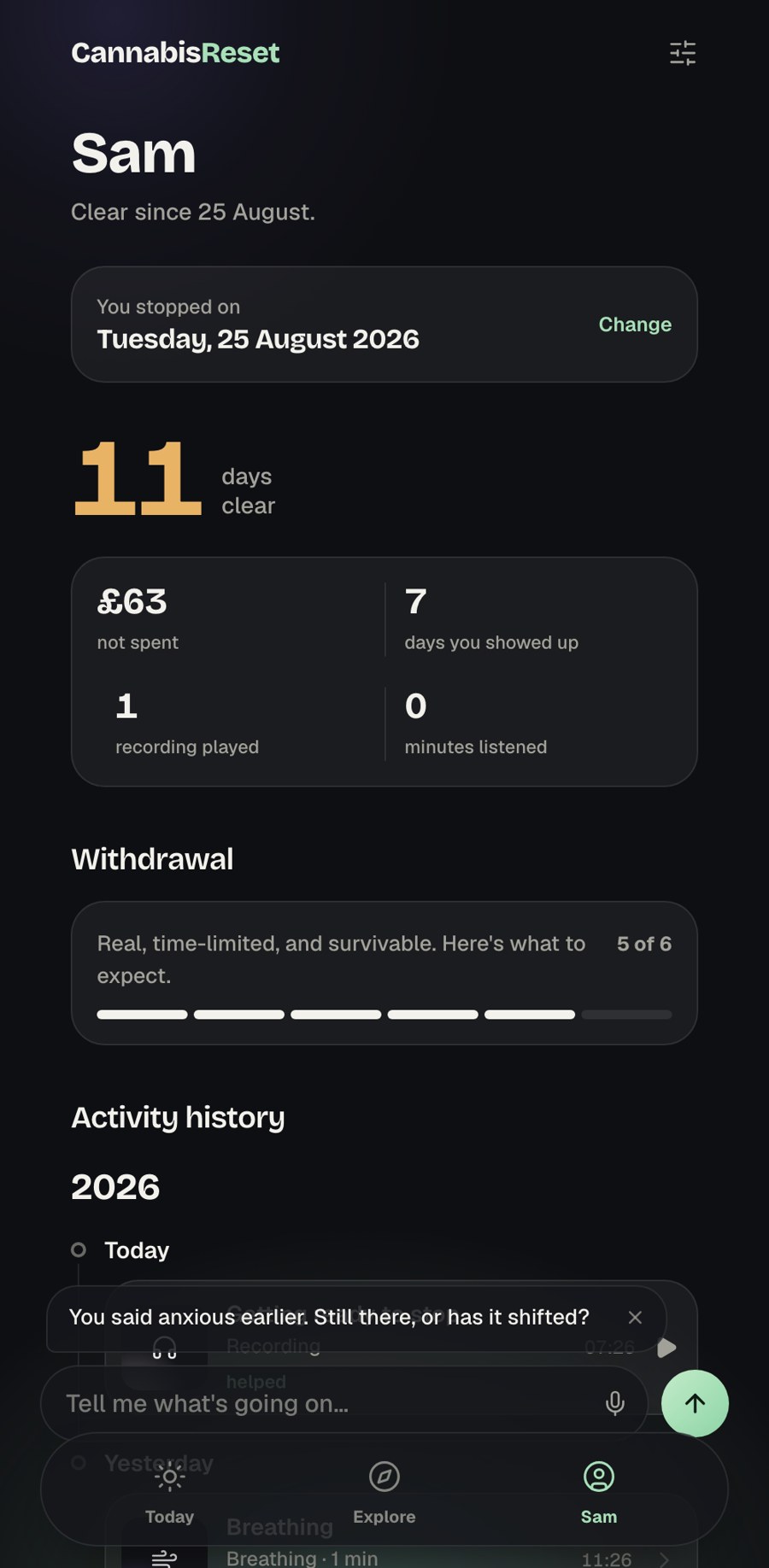
Nearly every quit-cannabis app on the market is a day counter. Streaks, sober-day tallies, money saved. Useful — until the first lapse resets the counter and the shame does the rest.
The book behind CannabisReset makes a different argument: cannabis dependence is emotional self-suppression. People smoke to mute boredom, anxiety, anger, sadness, fear. Recovery isn't counting days without weed — it's relearning to feel.
That thesis maps onto a genuine market white space: every competitor counts days, and almost none address the feelings underneath. CannabisReset tracks feelings, not just sober days.
Following the Evidence
Before designing anything, we studied 18 months of listening data from the book's audiobook edition. One number stood out:
54%
of listeners drop off in the first hour
Withdrawal
the exact chapter where they stop
~230k
daily cannabis users in the UK alone
People don't abandon the book because it stops being good — they abandon it at the moment the content turns to withdrawal, which is exactly the moment their own discomfort peaks. A linear book can't meet someone in that moment. An app can.
From Chapters to a Living Programme
The core product decision was to refuse the obvious build — a book-reader with a chatbot bolted on. Instead, each chapter became its own product surface. That thinking shipped as three places to be:
Today
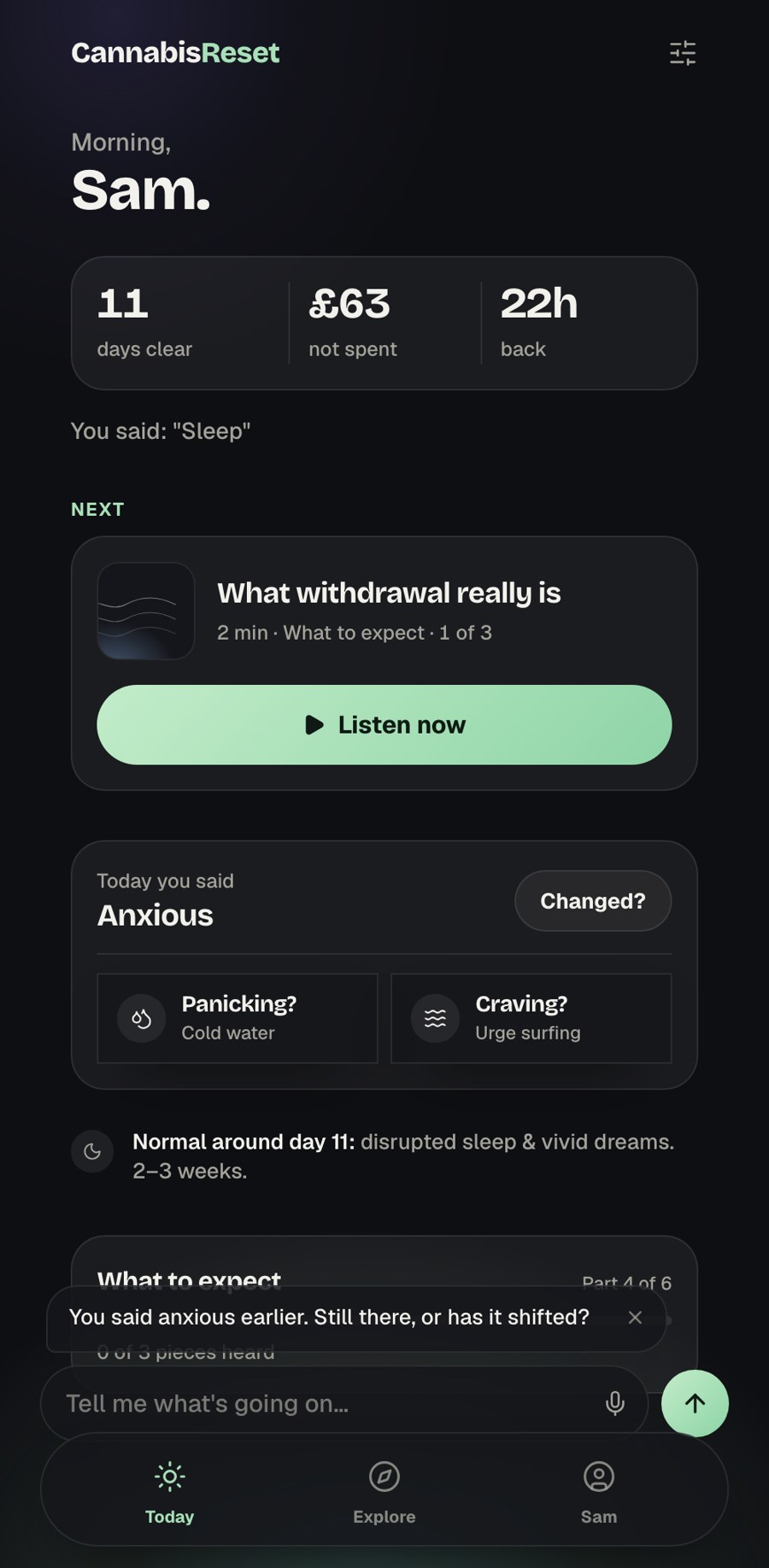
Where the day starts: how are you right now, answered in one tap, then the next thing in the programme and a quit date when you're ready to pick one. Never a streak, never a day count.
Explore
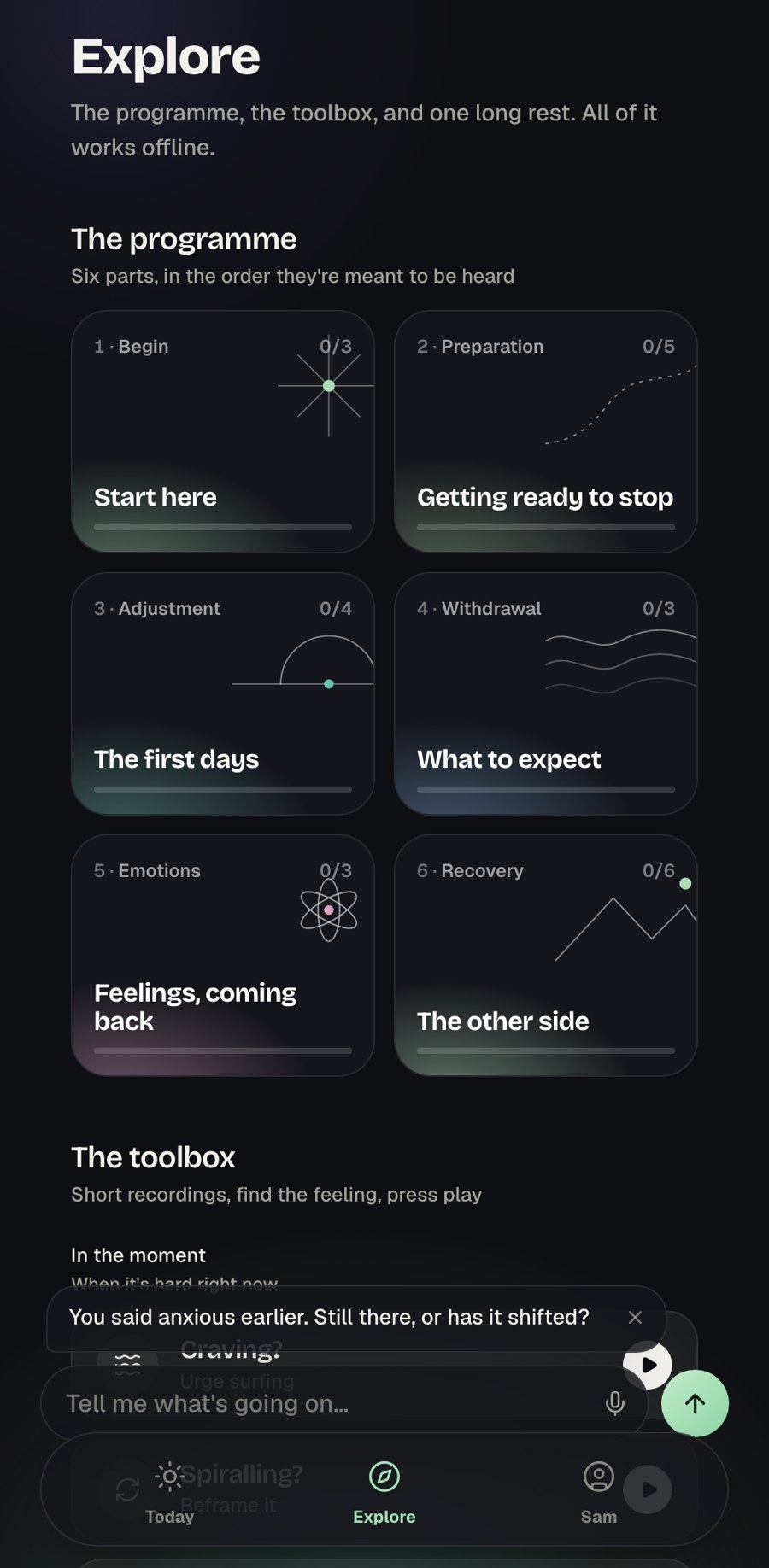
The programme in six parts — Begin, Preparation, Adjustment, Withdrawal, Emotions, Recovery — in the order they're meant to be heard, with progress tracked per part. Underneath sits the toolbox: short recordings you reach for in the moment.
The companion
One line at the bottom of every screen: "Tell me what's going on…". Always there, never demanding. It knows where you are in the programme and answers in James's voice.
A Companion With James's Voice
The centre of the experience is an AI companion grounded entirely in the book — James Langton's actual thinking, methods, and warmth, available at 2am when a craving hits. His voice, recorded and cloned with his participation, reads alongside you.
The guiding principle for every design decision: the app is James walking beside you. His lines, his non-judgmental framing, his "cut down or quit — your choice" stance. The voice is the moat, because therapeutic alliance is what drives recovery — and retention.
Underneath the warmth sits a clinical toolkit. The companion draws on a library of CBT, DBT, and ACT techniques — each grounded in the evidence for what it can and can't do — and matches them to the exact moment: urge surfing and distress-tolerance skills when a craving peaks, cognitive reframing when a thought spirals, playing the tape forward when "one joint won't hurt" shows up, behavioural activation when the day has gone sideways. Never the same tool twice in a row, never breathing exercises by default.
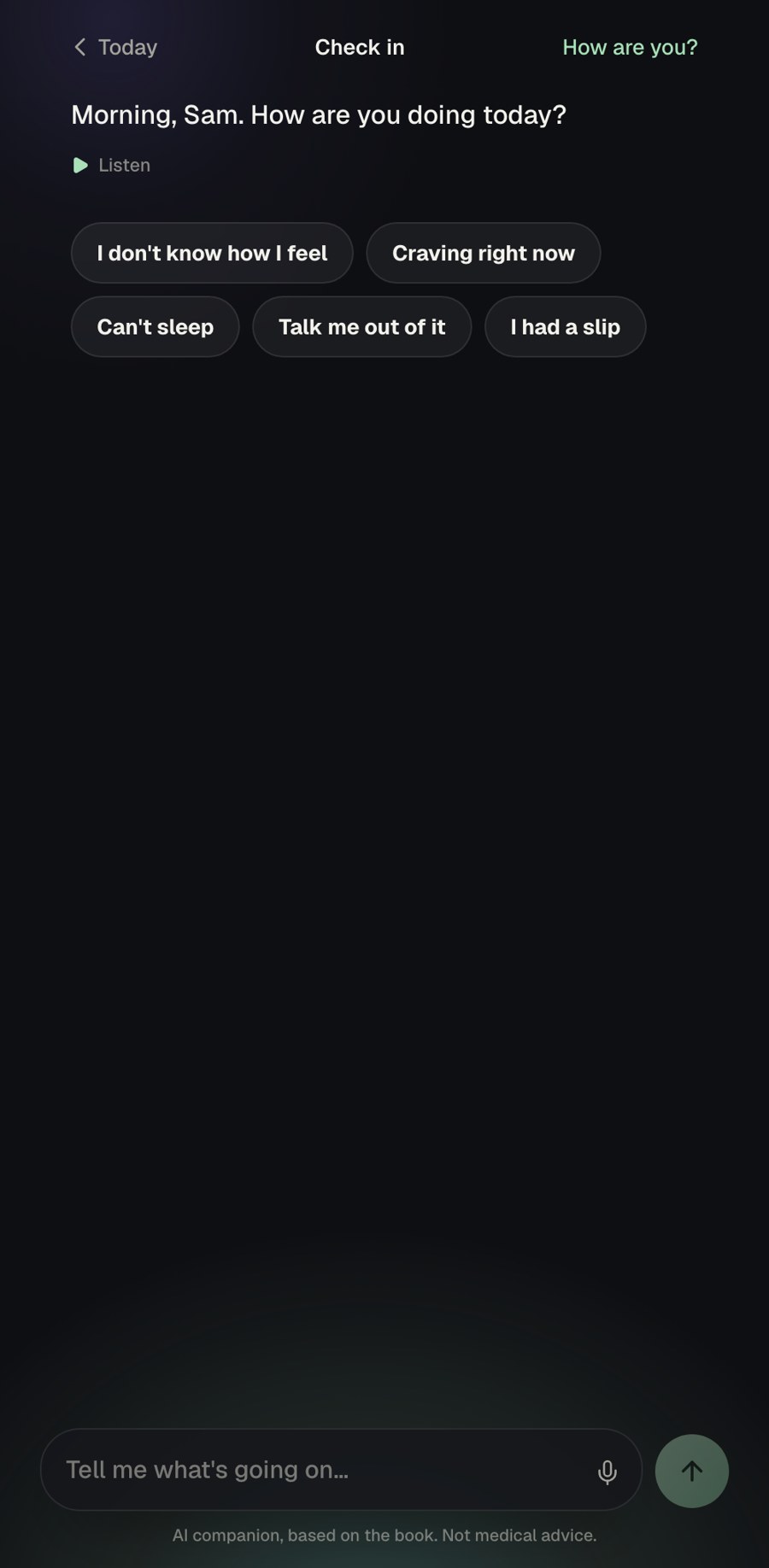
The companion opens where the person is, not with a blank box: craving right now, can't sleep, talk me out of it, I had a slip. Each route leads somewhere different — urge surfing when a craving peaks, playing the tape forward when "one joint won't hurt" shows up, and a fresh start rather than a reset counter after a slip.
CBT, DBT, and ACT techniques, chosen to match the moment — delivered in James's voice.A companion, not a clinic
Medical disclaimers in onboarding and every conversation, crisis signposting to real help, and a hard rule: this is a companion to the book, never AI therapy or medical advice.
The Business We're Building
- A fixed-length programme, not an open-ended subscription — a finite commitment mirrors how people actually quit, and how the book is structured.
- B2C first, B2B next — prove the programme with individuals, then bring it to universities, therapists, and public health services.
- UK-first — real crisis resources, UK spelling, and a focused market of roughly 230,000 daily users before expanding.
James owns the method, the story, and the relationships. I own the product: strategy, design, AI system, and the build itself — applying the same operating model I developed founding Loop Mind.
Where It Stands
Working prototype
Onboarding, the daily loop, the companion, and the library are functional and being refined with James ahead of launch.
Evidence-led scope
Every major decision — quit-first audience, programme pricing, emotion-first design — traces back to data or the book's tested method.
A repeatable pattern
Author-owned method plus AI companion plus founder-led build: a model for turning trusted recovery content into living products.
Built on a proven method
James Langton's workshops and book already work offline. The product's job is to carry that method to people the book alone can't reach.
Building something in mental health?
Whether you want a product partner, a second opinion, or just to compare notes between builders — I'd love to hear what you're working on.