After a decade advising mental health companies, I founded my own. Loop Mind is a voice journaling app that helps chronic overthinkers see the patterns in their own thinking — shipped to the App Store and shaped since by the people using it. Live today at loopmind.care.
Project Snapshot
Loop Mind
Voice journaling app that detects thinking patterns
2026 – Present
Founder
Product strategy, AI system design, full-stack delivery
Founder-led, with clinical research and user feedback shaping the build
Live on the App Store since May 2026
Strategic Insight
Overthinking is one of the most common mental health complaints — replaying conversations, spiraling before decisions, worrying about symptoms. Yet almost every app in the space responds the same way: journaling prompts, mood tracking, or a chatbot playing therapist.
None of them answer the question overthinkers actually have: what is my mind doing, and does it keep doing the same thing?
Loop Mind is not a journal, not a therapist, and not a mood tracker — it's a thinking tracker. You talk out what's looping in your head, and the app shows you the pattern: what kind of loop it is, what triggers it, and what keeps coming back.
Why I Built It
At Mentalyc, I spent 18 months designing systems that turn therapy conversations into clinical signals — therapeutic alliance, symptom patterns, treatment progress. The work convinced me of something bigger:
- Spoken thought is the richest mental health data there is — far richer than a mood rating or a typed entry.
- Most of that thinking happens outside the therapy room — between sessions, or for people who were never in therapy at all.
- AI had just become good enough to reflect thinking back to a person honestly, without pretending to be a clinician.
Loop Mind is the direct continuation of that thesis, applied to the consumer side — and this time, I wanted to own the outcome rather than advise on it.
The Product
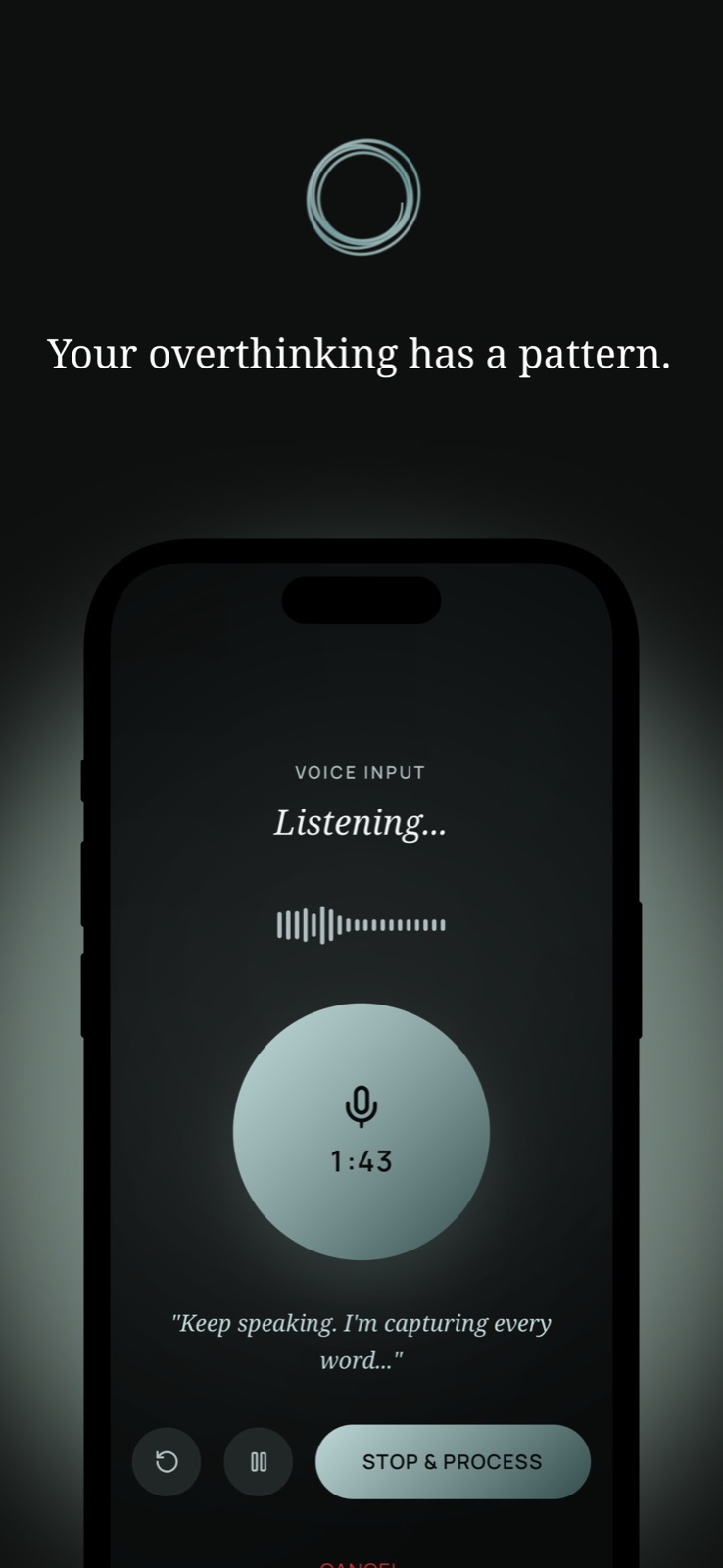
The core loop is deliberately simple: when your head is spinning, you talk. Speaking is lower friction than writing when you're spiraling — and it preserves the raw texture of the thought.
Voice-first capture
Press one button and talk. AI transcription handles the rest — no typing, no forms, no friction at the exact moment friction matters most.
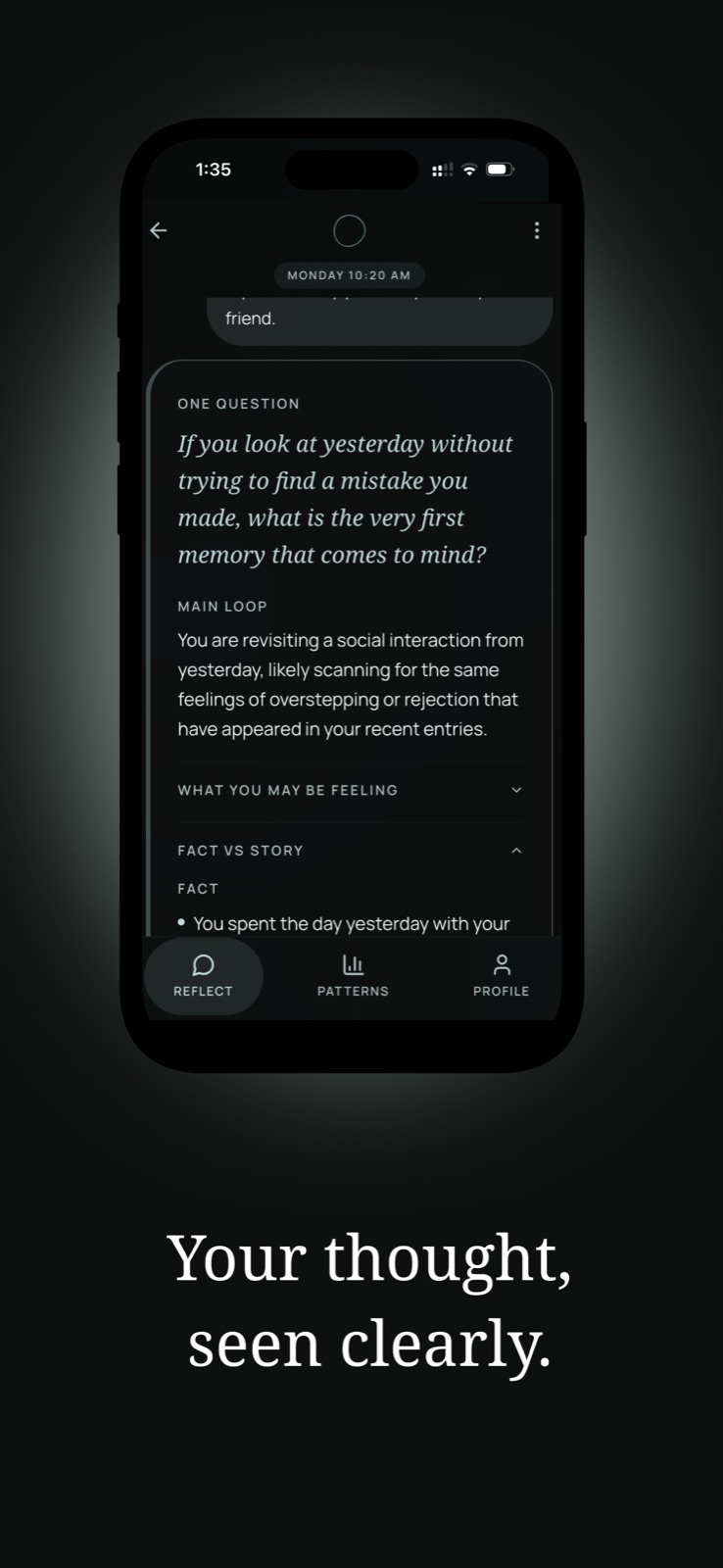
Honest reflection
Each entry comes back as a structured reflection: the main loop it detected, what you may be feeling, and a fact-versus-story breakdown of the thought.
A clinically grounded taxonomy
Every entry is classified into one of seven research-backed loop types — rumination, anticipatory worry, somatic (health) anxiety, and more — so patterns become nameable.
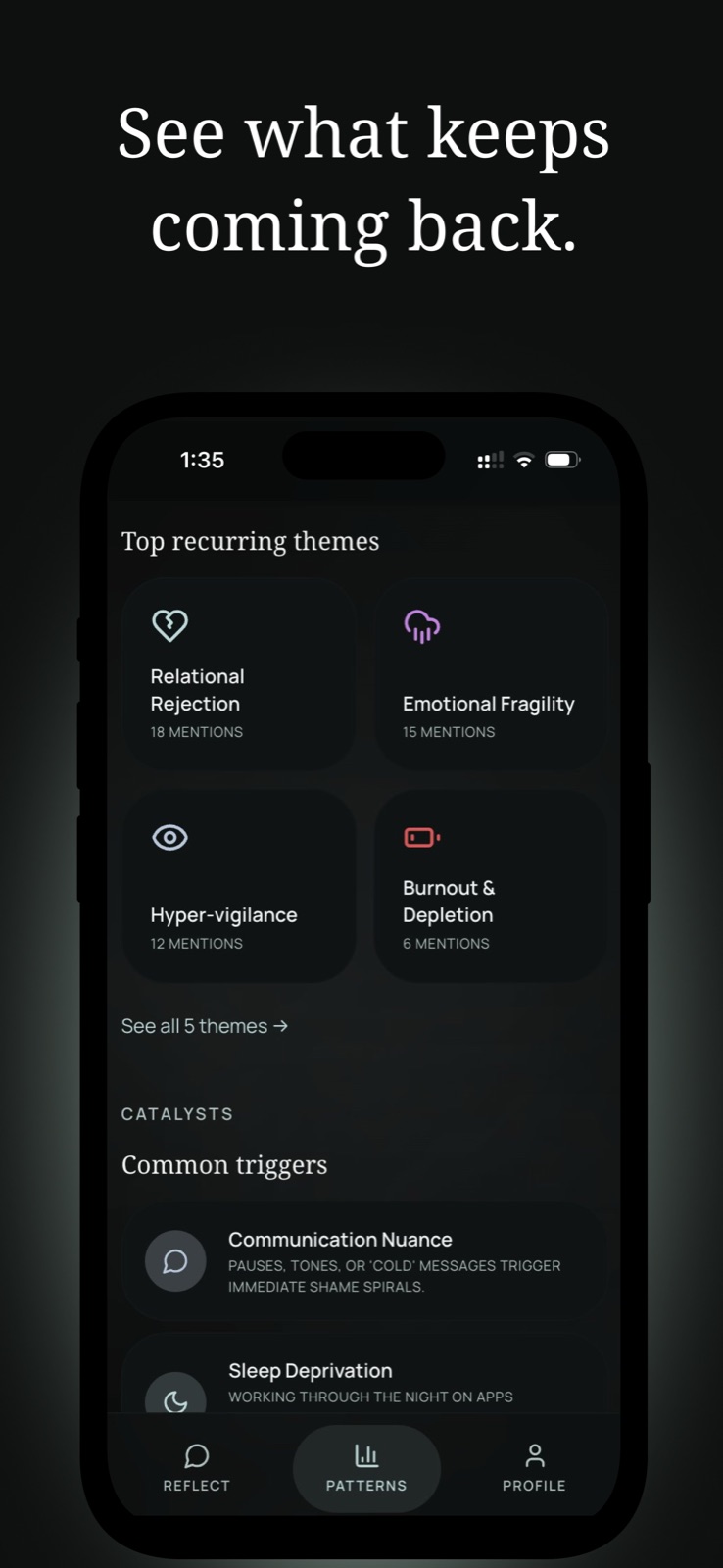
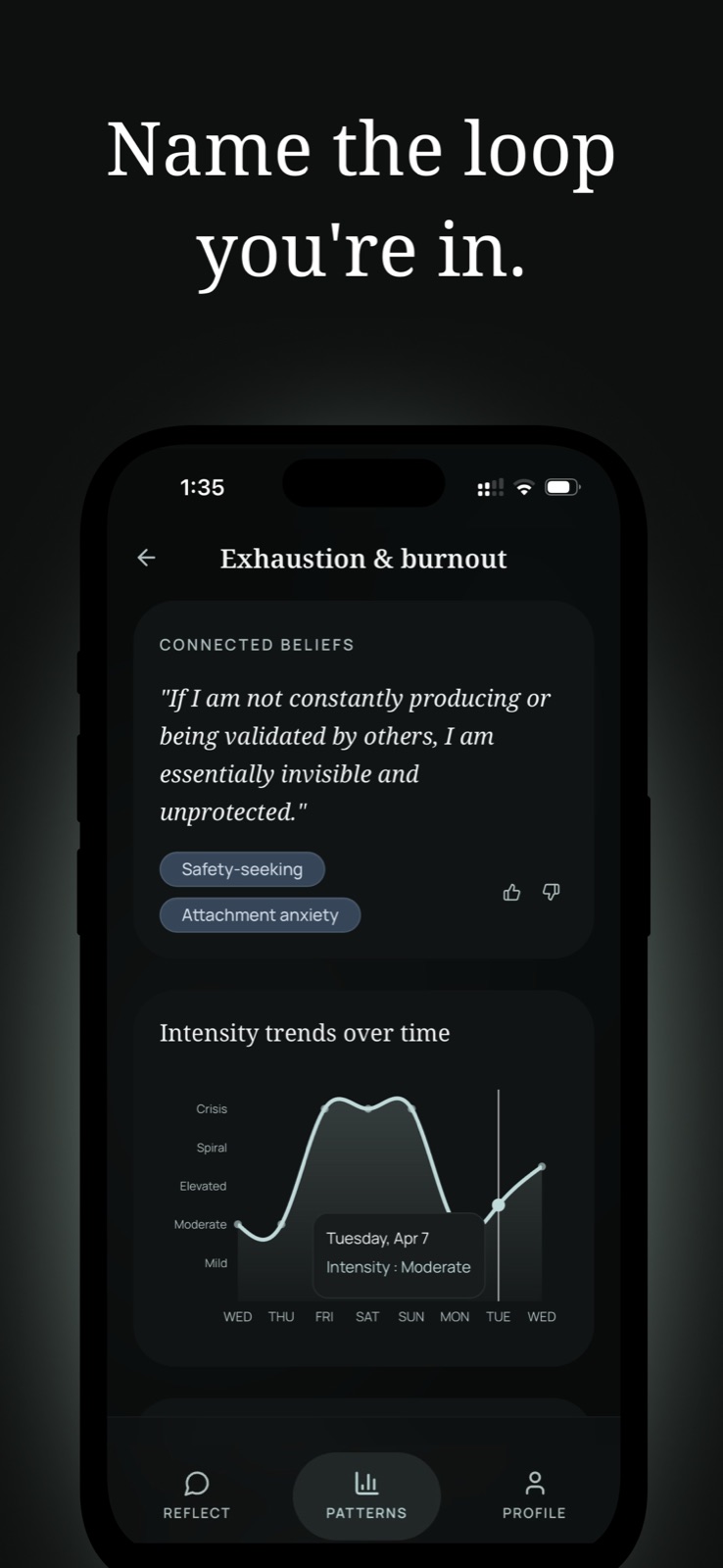
Patterns over time
Recurring themes, common triggers, connected beliefs, and intensity trends build up into a picture of how your mind actually behaves.
Clinically Grounded, Never Clinical
The hardest design constraint was positioning. Loop Mind sits next to therapy, not in place of it — its stickiest use case is people in therapy using it between sessions, because "it shows them things."
That constraint became a product test applied to every screen and every sentence of copy:
✓ Loop Mind territory
"See what your brain is doing" — observation, patterns, honest mirroring.
✕ Not Loop Mind territory
"Feel better about what your brain is doing" — treatment, advice, therapy claims.
The loop taxonomy is grounded in clinical literature — the somatic loop, for example, follows the health anxiety model of Salkovskis & Warwick — and it only earned its place in the product once real usage data showed enough entries fit it. The science is in the structure; the voice stays human.
One App Store screenshot carries the whole positioning in four words: "A mirror, not a therapist."
How It Gets Built
Loop Mind is also an experiment in how a small product gets built well. Modern tooling collapses the distance between deciding and shipping, which means the constraint moves from capacity to judgment — and judgment improves fastest with real users in the loop.
Users in the loop
Every release is shaped by what people actually say and do in the app. Feature decisions, copy, even the loop taxonomy itself get revised on real feedback rather than assumption.
Governance that survives speed
Every analytics event must name the decision it informs before it can exist. Every change passes a quality gate. The standard holds even when shipping weekly.
Infrastructure a team would envy
Over-the-air updates ship JS changes without an App Store cycle. Crash reporting, product analytics, subscriptions, and lifecycle email run as an integrated, audited stack.
Weekly
Ship cadence
7
Research-backed loop types
May 2026
Live on the App Store
What This Project Represents
The thesis, productized
Ten years of building mental health technology for others, condensed into one product I own end to end — from strategy to App Store.
AI as infrastructure, not therapist
A working demonstration of the positioning I advise clients on: AI that strengthens human insight instead of simulating care.
Built in the open, with users
A product that gets better because the people using it are part of how it is made, not just who it is made for.
Loop Mind is live today. Explore it at loopmind.care or find it on the App Store.
Building something in mental health?
Whether you want a product partner, a second opinion, or just to compare notes between builders — I'd love to hear what you're working on.